Monday, 26 January 2015
The spelling gremlin strikes ...
Apologies.
It seems that the Microsoft Word spelling gremlin came along behind me in my last entry on Chris Flint of Darraweit Guim and did a spot of auto-correction. And after I'd especially checked that I had the correct spelling!
This photo of a girder bridge at Darraweit Guim designed by Sir John Monash was taken by Lesley Alves in c1997. I imagine that Chris Flint crossed it many times.
And just so you can picture the sort of countryside Chris Flint worked:
Sunday, 25 January 2015
Chris Flint of The Grove: WW1 soldier and greyhound racing legend
The World
War One stories emerging from Coburg’s The Grove (or Moreland Grove, as it was
first called) have provided a glimpse of a richly diverse group of residents, unlike
those of any other street in Coburg, I would guess.
We’ve heard the stories of a number of the residents of The Grove now: Otto Neuendorf, a native of Berlin and photographer at Pentridge Prison during the WW1 era; Charles Dare, son of the developer of the area, Monty Dare; Richard Courtney of Courtney’s Post fame; Percy Cornwell of Cornwell’s Pottery in Brunswick; the Shawe brothers and their link to the British Raj.
And now it
is the turn of the Flint family,who lived at ‘Dunvargin’, 12 The Grove. Unusual
for this street (and Coburg enlistees) in that they were staunchly Catholic,
the six children of the family (all boys and all born in the local area)
attended firstly St Ambrose School in Brunswick then St Patrick’s College in
East Melbourne, where they excelled academically. Their father’s interest in
education is evident in his membership of the original Council of the Brunswick
Technical School and his continuing interest in the school council, taking up
the role of President in 1923.
Photo
of the Flint family: Arthur and Margaret Flint and sons Theo, Chris, Tom,
Claude, Arthur and Jack. Courtesy familyhistory blog of Nicole Close
The house
name, ‘Dunvargin’, speaks of an Irish background, Dunvargin being a seaside
market town in County Waterford. The family’s interest in the Irish question, which was
forefront in the minds of Irish Catholics everywhere after the Easter Uprising
of 1916, is evident in their membership of a newly established North Brunswick
Hibernian Society, based at the recently established St. Matthew’s Church, the
family church and in their participation in various Hibernian Society events.
The many
references to the sons’ academic successes speaks of a household of clever,
ambitious boys, and the electoral rolls show that they fulfilled their early
promise, most taking up careers in the civil service or the law.
Perhaps,
given their background, it is not surprising that only one of the six Flint
brothers enlisted – Christopher, the second son.
731 Sergeant Christopher Arthur Loftus Flint
When Chris
Flint enlisted in June 1917, he was attached to the 23/3 Machine Gun Company.
He was promoted to Staff Sergeant and worked as a clerk in the audit department
of AIF HQ in London where he was promoted to 2nd Lieutenant in
January 1919 and Lieutenant in April 1919. So, in many ways, although his
valuable contribution to the war effort was acknowledged in his war record, he was
unusual in that he did not see any action.
London, England. 28 September 1918. Horseferry
Road, looking towards Victoria Street, showing on the right AIF Administrative
Headquarters, and on the left the buildings occupied by the Australian War
Records Section. Image D00077. Image courtesy AWM.
Chris Flint returned
to Australia in September 1920 to the family home in The Grove, where he
remained until he completed university studies and qualified as a lawyer. He
married – to Mary Veronica Murphy – and had two sons, Christopher, who died in
infancy, and Geoffrey, who followed in his father’s footsteps and took up a
career in the law. His marriage appears to have failed, and the electoral rolls
over the years show that Chris and Mary lived apart from around the time he
moved to Mornington in the mid-1930s where he set up a legal practice.
It is almost
impossible from the official records to get any sense of Chris Flint, the man,
but a sense of his personality emerges from an unlikely source – Greyhound Victoria’s Hall of Fame. Here we
learn from family members that he could be difficult to get along with and that
he ‘wasn’t afraid to step on people’s toes if it meant he could achieve
something he believed in’. His nephew said that ‘if anyone got into an argument
with him, he’d [verbally] cut them to pieces.’ He was definitely not someone to
cross.
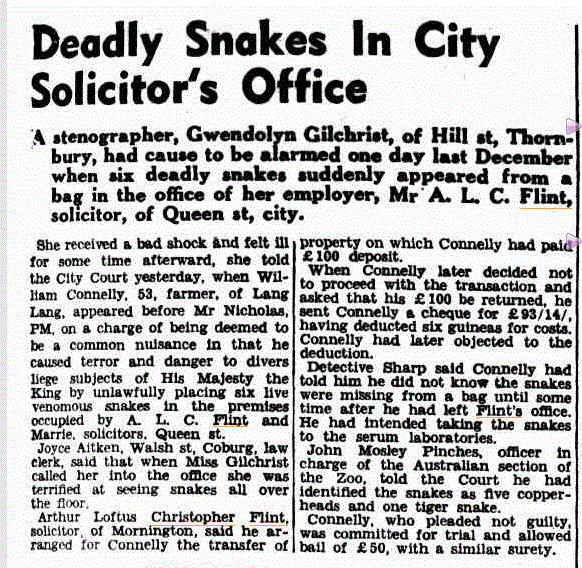
The
following newspaper report from the Argus,
1 February 1947, tells the story of a disgruntled client taking revenge for
perceived wrongs.
Photo
of coursing from Anecdotes of dogs, Edward Jesse, London, 1888.
What the
official records also don’t tell us, is that the Flint family had been involved
in coursing (greyhound racing) for many years. By the time Chris got involved,
there was great respect for the Flint family in coursing circles. His father,
Arthur, had been involved for more than forty years and there was an A.L. Flint
Memorial Cup presented annually. Chris was equally impressive and he was known
as a fearless and insightful administrator of the sport, whom his nephew
claimed ‘brought greyhound racing out of the dark ages.’ He was an impressive
figure, nicknamed the ‘Squire’.
Chris Flint.
Photograph courtesy Greyhound Racing Victoria
Geoff Flint,
son of Chris. Photograph courtesy Greyhound Racing Victoria
As well as
being outspoken and apparently fearless in his dealings with his opponents,
Chris Flint was remembered as a generous man, who bought his son and his wife
their first home. He also gave generously to the cause of greyhound racing in
Victoria. He donated money and used his public speaking skills, his legal
background, his understanding of human nature to negotiate some very difficult
times in the sport. He was involved at an administrative level from the 1930s
until his death and helped work through many difficult negotiations. He became
the first Chairman of the Greyhound Racing Control Board.
At the same
time, he maintained a legal career and at some stage, probably in the 1940s, moved
to Darraweit Gum, 50 kilometres north of Melbourne on the edge of the Shire of
Macedon Ranges, where he lived and worked 11,000 acres of land, land that was
devastated by rabbits and water erosion when he first went there, according to his
nephew. ‘He planted trees and cleared the rabbits. He really turned the place
around’, his nephew said. He had 10 people working for him to begin with, but
towards the end of his life much of the land was subdivided, although he kept
4,000 acres which he called ‘ Amesbury House’.
Chris Flint
was unwell for some years and died in 1958, aged 62.
Sources
include: Victorian BDM indexes and electoral rolls (via Ancestry), Coburg Leader, 31 January 1913, p.1; Brunswick and Coburg Leader, 23 January
1914; Tribune, 4 April 1914, p.7; Brunswick and Coburg Leader, 2 April
1915, p.2; Tribune, 4 May 1916, p.5; Advocate, 16 December 1916, p.25; Advocate, 14 July 1917; Argus, 12 December 1918; Argus, 10 December 1920, p.11; Argus, 19 February 1923, p.8; Table Talk, 23 April 1925, p.5; The Australasian, 25 August 1934; Australasian, 23 May 1936, p.51; Australasian, 23 August 1936, p.57; Australasian, 28 November 1936,
p.24; Argus, 12 August 1939, p.14; Argus,
1 Feburary 1947, p.21; WW1 service record of Christopher Arthur Loftus Flint ; WW2 service record of Geoffrey Vincent Flint; Greyhound Racing Victoria’s Hall of Fame
Sunday, 18 January 2015
The Shawe brothers of The Grove: Coburg’s connection to the British Raj
When the
Shawe family took up residence at 50 The Grove, Coburg in the early 1900s, they
had been in Australia for only 10 years. Before that the family had been residents
of Madras (now Chennai), the base of the British India Office for almost a
hundred years.
For three generations,
members of the family had been baptised, married and buried at St Andrew’s
Church, Madras, pictured here in the 1840s and again in more modern times.
Coloured aquatint with etching by J.V. Gantz of St. Andrew's Church at
Madras, dated 1841, courtesy British Library online gallery
John,
Patrick and William Shawe were all born in the Madras area in the 1880s and
baptised at St. Andrew's. Their father, Charles Barron Shawe, an Inspector in the
Salt Revenue Department of the India Office, had been baptised there and
married the boys’ mother Annie Eleanor Walker there. His parents had been married there in 1833 and his father's siblings were also baptised there. It was their parish church.
Merchants’ Buildings
1829. Courtesy British
Library online gallery
What motivated the
family to come to Australia is not known. It seems an unusual choice. The 1851 census shows that their
father and his sisters had been sent back to England to be educated. Charles
Shawe’s sisters had settled in Notting Hill in London and his father had retired there and died there in 1891, not long before Charles brought his family to Victoria.
For whatever reason, Charles Shawe
chose Melbourne as his retirement destination. He lived comfortably on his British Office pension, buying a home in one of Coburg's most exclusive locations.
His sons attended nearby Carlton College where they excelled academically.
Three of the sons, John, his twin brother George and Patrick, took up
banking careers. The fourth brother, William, chose a different path, moved to Pyramid Hill and became
a farmer.
1190 Pte John Fawcett Shawe, 7th Infantry Battalion
The first son to enlist
was Jack, the second son of the family. His twin brother George did not enlist. He was the older of the two, so
perhaps he chose not to enlist because he was the eldest son, even if only by minutes. Jack enlisted in
September 1914. Just a few months later,
at the end of December, the boys’ mother Annie died aged 62. Their sister Hester
was on hand to look after her father and brothers, but it must have been a sad
household that new year.
Jack’s was not a long
war. He was wounded three times on the Gallipoli Peninsula - on 25 April 1915
(gun shot wound to right leg), July 1915 (gunshot wound to chest) and August
1915 (gunshot wound to sides and thigh). By March 1916 he was on his way home.
It seems that Jack
Shawe did not marry. He left Victoria in the 1930s and by the 1940s he was working
as a clerk in Wynnum in Queensland. His last entry in the electoral rolls was
in 1968, so it is likely that he died around this time.
6901 Private
Patrick Henry Villiers Washington Shawe, 24th Infantry Battalion
The next
brother to enlist was the youngest, Patrick, on 31 August 1915. He served
without injury until September 1918 when he was wounded and invalided to
England with a severe gunshot wound to his head and neck. His war was over and
he chose to return to Australia via America in April 1919 at his own expense.
Patrick married
Mary Hatton at Christ Church, South Yarra in 1920 and they moved to Lismore,
NSW. He did not return to the Coburg area, but by the mid-1930s he was back in
Melbourne, living in the south-eastern suburbs. He died in 1945 aged 56. His
wife died in 1974.
3249 Pte
William Charles Shawe, 21st Infantry Battalion
Middle brother William, the farmer from Pyramid Hill, enlisted on 31 August 1916. By 19 July 1917 he was dead, a casualty of the
Battle of Fromelles. An eye witness said that he was ‘one of the first to be
knocked out during the stunt.’ William Shawe must have died not long after the
following photograph was taken.
AWM. Image A02555. Taken on
19 July 1916. Looking from a sandbag trench to the bombardment of the German
lines, ten minutes prior to the attack on Fleurbaix which was fought on the 19
July 1916 and 20 July 1916.
In just a
few years, Charles Barron Shawe, now an elderly man, suffered the loss of his
wife, welcomed home his injured sons and experienced the loss of another. Looked
after by his unmarried daughter Hester, he remained at The Grove where he died
on 11 August 1919 aged 75. He and his wife are buried in the Church of England
section of Coburg Cemetery, a long way from their homeland, British India.
The sons who
did return from the war did not remain in the Coburg area. Although their
sister Hester was buried at Coburg Cemetery when she died in 1935, she was then
living in East St. Kilda. So it seems that with the death of Charles Barron
Shawe in 1919, Coburg’s short connection to the British Raj came to an end.
Monday, 12 January 2015
Percy Cornwell of Cornwell's Pottery
Lieutenant Percy Vernon Reginald Cornwell,
Armoured Car Section, taken c. 8 May 1916. Image courtesy AWM. Image DACS0119.
Percy Cornwell, proprietor of the Cornwell
Pottery Works in Brunswick, was another resident of The Grove, Coburg who
enlisted in the 1st AIF. At
the time of enlistment in March 1916, he was 33 years old and living at 35 The
Grove with his brother Frederick, who was his next of kin. Their sister lived
there with them.
Cornwell’s Pottery was founded by Percy’s
father Alfred in 1861. It prospered for some time, but in the years after WW1
its fortunes waned. It struggled on until 1959 when it finally closed.
Percy Cornwell married Adele Sleeman in
1920 and moved to Ivanhoe. He died at Armadale in 1962 aged 85.
Before he left for the war in June 1916, Members of the Victorian Stoneware Pipe, Tile and Pottery Manufacturers' Association entertained Percy Cornwell at a dinner at the Cafe Francais where he was presented with a portable typewriter. (Brunswick and Coburg Leader, 2 June 1916)
Argus, 26 Oct 1916, p.6
I can't help wondering if he wrote letters home on that typewriter, and if he did so, whether they are sitting in an archive somewhere. I would be delighted if anyone can enlighten me!
The same newspaper article revealed that Percy Cornwell presented an armoured motor car to the Defence Department, and was put in charge of the car. (Brunswick and Coburg Leader, 2 June 1916) If this
was the case, it must have been one of the cars in the following photograph.
Group portrait of the men and vehicles of the 1st
Armoured Car Section prior to their embarkation. Image courtesy of Australian
War Memorial. Image P09255.001.
The fact that the Armoured Car Section was made up of only three cars is a
reminder of how cutting edge this technology was. Looking at the cars, it’s a
wonder they protected anyone from anything and if Percy Cornwell donated the
car he was in charge of, it makes me wonder whether the other two cars were
also donations. It seems I have another aspect of WW1 to research!
According to the website of the Australian War
Memorial, the 1st Australian Armoured Car Section was formed in Melbourne
during 1916 and was also known as the 1st Armoured Car Battery. It was equipped
with three armoured cars built at the Vulcan Engineering Works in South
Melbourne, a 50 HP Daimler, a 60 HP Mercedes and a 50 HP Minerva. All were
armoured and the Daimler and Mercedes were armed with Colt machine guns. The
unit fought against the Senussi in the Sudan and Western Desert.
The 1st Armoured Car Section became the 1st Light
Car Section on 3rd December 1916. As their original three vehicles became worn
out from hard use in the Western Desert and were irreparable due to shortages
of spare parts, the unit was re-equipped with six Ford light cars. Extra
drivers and motorcycles were provided. The cars were given names: Anzac,
Billzac, Osatal, Silent Sue, Imshi and Bung. These were traded in for six new
Fords on 11th December 1917. In May 1917 the unit was redeployed to Palestine
by rail, and served throughout the campaign there.
Wednesday, 31 December 2014
Courtney of Courtney’s Post
Until
very recently I was unaware that Colonel Richard Edmund Courtney of Courtney’s Post fame had a connection
to Coburg.
Then I
read the reminiscences of Dr Randolph Mathew in an article in an old Coburg
Historical Society Newsletter (February 1977). The Mathew family lived in The
Grove, Coburg during the early years of the twentieth century. Dr Mathew and
his brothers Alexander, John and Mungo all served in the First World War.
Theirs was an interesting family. Their father John was the Presbyterian
minister at Coburg and a well regarded anthropologist. He was also a great patriot and on the first
big Armistice Day celebration in November 1919, he flew the Union Jack from the
tower of his home, held a brief ceremony and all present wrote their names on
the tower door.
Further into the article, Dr Mathew made reference to Charlie Dare, son of the
developer of the Moreland Park Estate, Monty Dare, and Charlie's friend – ‘a man named Courteney’.
Charlie Dare was Colonel Charles Moreland Montague Dare of the 14th Battalion.
In fact, he was the Battalion’s war diarist.
Despite
the incorrect spelling of his surname, a little detective work reveals that
the ‘man named Courteney’ was in fact Lieutenant-Colonel Richard Edmund
Courtney, who had been the first commander of the 14th Battalion. On 27 April 1915 he had brought the 14th up to a position at
Gallipoli that then took his name - Courtney's Post.
The
two men had been comrades in arms, had probably known each other before they left for the war and clearly maintained their friendship on
their early returns from the war (Courtney in 1916 due to heart strain and Dare
in 1917 to take up staff duties in Australia). Why else would they lay out a
field telephone between their two houses?
Lieutenant
William Hugh Hamilton (left), a Graduate of the Royal Military College,
Duntroon ACT, of Ballarat, Vic, who was killed on 18 May 1915 at Gallipoli.
Colonel Charles Moreland Dare sitting in a chair, smoking a pipe in centre and
Colonel Richard Edmond Courtney sitting in a deck chair outside a tent at the
Heliopolis Camp. Taken in 1915 at Heliopolis in Egypt.
Image courtesy AWM. Image A01228.
Courtney,
a solicitor in civilian life, died in October 1919 of health problems
aggravated by his war service. He is buried at Coburg Cemetery. His name has
only recently been added to the Debt of Honour Register by the Commonwealth War Graves Commission, thanks to the efforts of Essendon’s Lenore Frost.
Interestingly, his medal group and war papers have been purchased by the Maryborough Military Museum in
Queensland, so you will have the perfect excuse for a holiday in the sun if you
want to look at them in person!
Although
the Courtneys had strong connections to the Cheltenham area, the family
had lived in Coburg since around the turn of the century and
Courtney’s unmarried sister Isabella, who was his next of kin, remained in the area until her death in 1954. Several
brothers also served with distinction: one was Colonel J.H. Courtney and the
eldest brother was Brigadier-General Thomas John Courtney.
Monday, 8 December 2014
Chaplain William Devine of St Paul’s, Coburg
4th Class Chaplain Major William Devine, Chaplains
Twenty-seven year old
Irishman William Devine enlisted as an army chaplain in July 1915. Born in
Castlederg, County Tyrone, he gained a BA and BD in Ireland and came to
Australia in 1914. He had been assistant parish priest to the elderly Fr
Matthew Hayes at St Paul’s, Coburg for twelve months at the time of his
enlistment. His older brother George (who signed as de Vine) served with the
British forces. He attested in February 1916 with the Royal Horse and Royal Field Artillery,
having previously served with the Royal Army Medical Corps for twelve months.
Usually we see parents or
siblings or other family members listed as next of kin, but as he was a Roman
Catholic priest Chaplain Devine listed his next of kin as the Dean of St
Patrick’s Cathedral, Melbourne and Archbishop Carr, Chaplain General,
recommended him as a military chaplain.
Fr Devine served with
distinction and was awarded the Military Cross and the Croix de Guerre. The Australian Dictionary of Biography records that he spent most of his time with the 48th
Battalion and that he wrote about the Battalion’s war experiences just after
the war ended.
Image courtesy AWM. Image C04450. Group
portrait of the Bishop of Amiens and a party of Australian officers. Back row,
left to right: Chaplain Reverend W. Devine MC, 12th Australian Infantry
Brigade; Lieutenant Henderson, 48th Battalion, 12th Australian Infantry
Brigade; unidentified (hidden); Lieutenant Colonel S. L. Perry DSO MC, 48th
Battalion; Brigadier General Sydney C. E. Herring DSO, 13th Australian Infantry
Brigade; unidentified (hidden). Front row: Major W. Fowler-Bunnsworth MC, 4th
Division; Major General (Maj Gen) John Gellibrand CB DSO, commanding 3rd
Australian Division; Bishop of Amiens; Maj Gen E. G. Sinclair-Maclagan,
commanding 4th Australian Division; Captain A. Nicholson, 18th Australian
Infantry Brigade; Capt C. Bartlett, 4th Division. (Donor Herring)
In
February 1919 he became seriously ill with broncho-pneumonia and was
hospitalised in London. After his return to Australia in May 1919, he organised for fourteen Victoria Cross winners to act
as Archbishop Mannix’s guard of honour in the famous 1920 St Patrick Day’s
procession.
St Patrick’s Day Procession, 1920. Australasian, 27 March 1920, p.51
You can read more about the 1920 St Patrick’s Day
Procession here.
Here are the 14 VC winners, some Catholic and some Protestant:
Image
courtesy AWM. Image P01383.018.
This is a
restored version of P01383.017. The original is is a framed composite
photograph presented to Lieutenant John Hamilton VC by his Grace the Archbishop
of Melbourne and the Irish citizens of Victoria on the occasion of the Saint
Patrick's Day celebrations in Melbourne, 17 March 1920. The composite
photograph comprises portraits of fourteen Victoria Cross winners (ten Roman
Catholics and four Protestants, all presumably with Irish backgrounds) with
portraits of his Grace Dr Daniel Mannix (the Roman Catholic Archbishop of
Melbourne) and the entrepreneur John Wren in the centre. The VC winners
comprise Private (Pte) William Currey, Sergeant (Sgt) George Howell, Corporal
(Cpl) Walter Peeler, Pte John Jackson, Lieutenant (Lt) Joseph Maxwell, Lt John
Dwyer, Sgt Maurice Buckley (he was accidentally killed the following year) Pte
George Cartwright, Cpl Thomas Axford, Cpl John Carroll, Pte Edward Ryan, Sgt
John Whittle, Lt John Hamilton, Lt Lawrence McCarthey. It was probably financed
by John Wren.
You will find more
information on the image here.
And another image showing the
14 VC winners:
Courtesy State Library of
Victoria. Image H2010.179
The State Library of
Victoria’s notes for the image read: This image shows Archbishop Daniel Mannix in a car in front of a
large house, possibly his residence Raheen. The car is surrounded by 14 VC
heroes, most on white horses and some seated beside Dr. Mannix in the car,
forming a guard of honor for Dr. Mannix, St. Patrick's Day Celebration, 17
March 1920. Victoria Cross winners (ten Roman Catholics and four Protestants,
all presumably with Irish backgrounds) comprise Private (Pte) William Currey,
Sergeant (Sgt) George Howell, Corporal (Cpl) Walter Peeler, Pte John Jackson,
Lieutenant (Lt) Joseph Maxwell, Lt John Dwyer, Sgt Maurice Buckley (he was
accidently killed the following year), Pte George Cartwright, Cpl Thomas
Axford, Cpl John Carroll, Pte Edward Ryan, Sgt John Whittle, Lt John Hamilton,
and Lt Lawrence McCarthey. A lady is seated on a white horse draped in a green
blanket with a banner titled "Old Kilmore" and a shamrock on it.
Now back to Fr Devine …
Fr Devine later returned
to Ireland but moved on to serve in China in 1927, where he stayed for three
years before returning to Ireland. He died in Dublin in 1959.
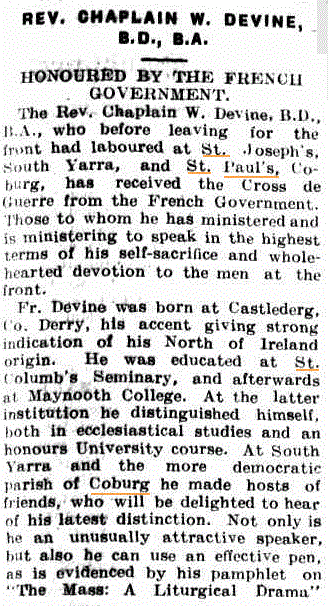
The following article from the Advocate, 12 May 1917,
gives an insight into William Devine the man, something that cannot be conveyed
in the official record.
Subscribe to:
Posts (Atom)