Saturday, 24 March 2018

George Hepworth - an 'Old Contemptible'


I recently came across a newspaper article in the Coburg Courier dated 16 March 1976 entitled 'Final tribute to an 'old Contemptible'.

The 'Old Contemptible' was George Hepworth of Landells Road, Pascoe Vale and he had just died aged 80. The article mentioned that another 'six of Victoria's most famous "Diggers"' were at his funeral, then aged between 80 and 90. One of them, Fred Long, held the 'Old Contemptibles' flag while the Last Post played. The article also mentioned that with his death, only 10 'Old Contemptibles' were left in Victoria.


Age, 25 August 1947. It's possible that George Hepworth is in this photo.


These World War One veterans took their name from the Kaiser's derisive term for them - 'Sir John French's contemptible little army'. Any British Empire Force soldier who served in France or Flanders between 5 August and 22 November 1914 could call themselves an 'Old Contemptible'. 


Sydney Mail, 24 April 1935

The Courier article gives more details:
Sixty thousand of their fellow British soldiers died in the retreat from Mons during the French campaign of World War 1.
 Eight British divisions, pitted against 45 German divisions, managed to inflict heavy German losses.
The Kaiser's order to his officers was to 'wipe the contemptible little British army into the sea.'
After the battle the 20,000 survivors all over the world formed the 'Old Contemptibles Association.

In June 1925 an Old Contemptibles Association was founded and soon it had 178 branches in the UK and 14 branches overseas. Perhaps the most active Australian branch was here in Melbourne.


Age, 23 August 1954.


Herbert George Hepworth (known as George) was a 30 year old hotel porter when he arrived in Melbourne in February 1926. He spent some time in Albury, NSW but after his marriage to Clara (known as Corrie) Newton in 1938, he settled in Melbourne and spent some years in Box Hill before moving to Pascoe Vale. He died in 1976, his wife in 1991. They are buried together at Fawkner Memorial Park.

AND

If you are interested, there is an Old Contemptibles Facebook page. Well worth visiting!


Sources:
https://livesofthefirstworldwar.org/community/930
Coburg Courier, 16 March 1976
Victorian Birth, Death, Marriage indexes
UK Outward Shipping Records (accessed via Ancestry)
UK WW1 Military records (accessed via Ancestry)
Fawkner Cemetery records
NSW and Victorian electoral rolls (accessed via Ancestry)
Sydney Mail, 14 November 1934
Sydney Mail, 24 April 1935
Age, 25 August 1947
Age, 26 April 1948
Argus, 25 April 1953
Horsham Times, 23 December 1953
Age, 23 August 1954


Thursday, 1 March 2018

Sister Bannan and her Strathnaver Private Hospital, Merlynston


After the death of Donald Stuart Bain in January 1937, Ellen Sharp Bannan and her husband William set up home at 21 Orvieto Street, Merlynston.

The couple had arrived in Australia in late 1913 from Scotland where William Bannan had worked as a coal miner. They and their 5 year old son James settled in  Korumburra. In February 1914, just four months after their arrival, James died in devastating circumstances: he was bitten by a snake and not realising the seriousness of the situation, they did not seek medical attention until it was too late.


Great Southern Advocate, 26 Feb 1914


Argus, 27 Feb 1914   


In September 1915 William Bannan enlisted at Wonthaggi. 482 Pte William Bannan, 2nd Tunnelling Company embarked on 20 February 1916, two years after the death of his son, his only child. He was wounded in France on 29 September 1918 and invalided to the UK. He returned to Australia on 12 December 1918 with a shell wound to the back.


In late October 1916, some months after William’s departure for the war, Ellen Bannan (known as 502 Nellie Sharp Bannan in the nursing registers) returned to her occupation as a registered nurse. From this point until her death in 1972 she is referred to as a nurse in the electoral rolls. At first she worked as a midwife in the Foster area of Gippsland. In mid-1917 she was nursing at the Base Hospital in St Kilda Road (No. 5 AGH) until its closure in September 1918.


Argus, 18 September 1918


On his return, William Bannan applied successfully for a Soldier’s Settlement block at Numurkah. There Nellie continued her work as a midwife while William farmed their block ‘Penman’ at Mundoona.


Views of Numurkah, c1907. Image H90.140/848. Courtesy State Library of Victoria. 


Like so many other soldier settlers, the Bannans did not remain on the land. By the end of 1926 they were back in Melbourne where they settled in Whitelaw Street, Reservoir and Nellie Bannan resumed work as a registered nurse.


High Street, Reservoir, c1920-1954. Image H32492/1757. Courtesy State Library of Victoria.


In the 1930s the Bannans moved to 30 Mary Street, Preston where Nellie, now Sister Bannan, conducted her Willhellar Private Hospital. As well as midwifery, she looked after dying patients, at least one of whom was the widow of returned Anzac hero 46 Sergeant James S. Hopkins DCM MM, a Preston resident.

In 1937, not long after the death of Donald Stuart Bain, Nellie and William Bannan moved into 21 Orvieto Street, Merlynston and it was from there that Sister Bannan ran her small private hospital ‘Strathaven’, named after William Bannan’s birthplace in Lanarkshire, Scotland.

William Bannan died on 14 October 1942 aged 55 years. In July the following year Nellie sold the business and returned to the Preston/Reservoir area where she continued to nurse. Between 1954 and her death in 1972, she lived in Plenty Road, Reservoir. She died aged 84 and in electoral rolls and on her death certificate her occupation is given as nursing sister, so presumably she never gave up working.


The Bannans are buried together in the Baptist section of Fawkner Memorial Park. Their only child James is buried in Korumburra. Until the very end of my research I assumed they had no other family in Australia. However, in William Bannan’s death notice there is a son Jack listed and when Ellen Bannan died in 1972 her foster son John Ball, of Munro Street, Brunswick was the informant. 


Nothing else is known of John Ball or how he came to be part of the Bannan household. One can only hope that theirs was a happy home.


Sources:
Scottish Census records (accessed via Ancestry)
Victorian electoral rolls (accessed via Ancestry)
Sands and MacDougall Street Directories
Victorian Birth, Death, Marriage Indexes
Victorian Death Certificates for James and William Bannan
Victorian Shipping Records (accessed via PROV website)
WW1 records of William Bannan and James Stanley Hopkins (accessed via the NAA website)
State Library of Victoria Picture Collection
Great Southern Advocate, 26 February 1914
Argus, 27 February 1914
South Gippsland Shire Echo, 1, 8, 15, 22 December 1916
Argus, 18 September 1918
Argus, 25 November 1918
Victorian Government Gazette, December 1920, December 1926, December 1929, March 1938
Age, 18 May 1927
Age, 2 May 1930
Age, 25 April 1936
Age, 25 January 1937
Age, 5 March 1938
Coburg Courier, 6 July 1938
Shepparton Advertiser, 5 May 1941
Argus, 15 October 1942
Argus, 17 July 1943
Numurkah Leader, 16 May 1944
Age, 14 July 1945
Age, 13 June, 1946


Saturday, 24 February 2018

Donald Stuart Bain, founder of Merlynston


Donald Stuart Bain, c1935. Courtesy Coburg Historical Society.


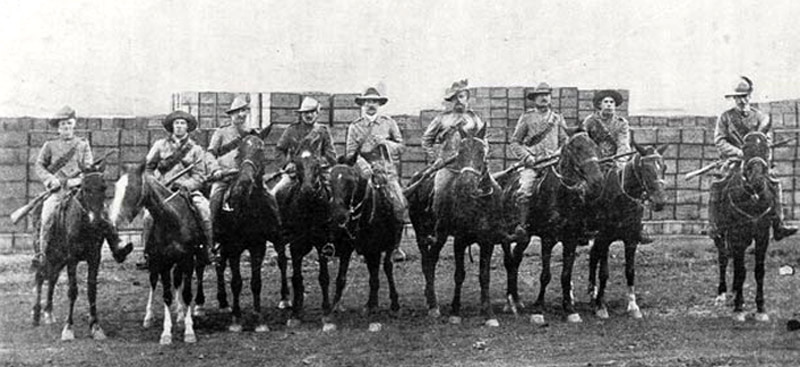
Donald Stuart Bain was born at Berwick in 1880 and his early military training was undertaken as a member of the Berwick Cadet Corps. As a 20 year old he enlisted in the Boer War and served as a Trooper in the Kaffrarian Rifles then as a Lieutenant in Kitchener’s Fighting Scouts (2nd Battalion).


Members of the 2nd Kitchener's Fighting Scouts, from the Anglo Boer War website but taken from the supplement to the Auckland Weekly News, 13 February 1902, p2.


In 1910 Bain married Lillian Nathan, daughter of Simeon Nathan, furniture merchant and local government councillor. The Nathans were a well connected family. Lillian’s brother Harold was the managing director of Patersons Pty Ltd. (and his son Sir Maurice Nathan served as Lord Mayor of Melbourne from 1961 to 1963.) So his marriage into the Nathan family brought with it links to the business world, to local government and to a world of privilege.

In 1911, the Bain’s only child Merlyn was born at Malvern. Three years later, 34 year old Donald Bain, veteran of the Boer War then working as a stock and station agent based in Collins Street, enlisted in the 5th Battalian AIF. He embarked as part of the first convoy on 21 October 1914 on board its flagship, HMAT A3 Orvieto.


Orvieto at Alexandria, courtesy Australian War Memorial. Image PS0368.


You can read about some of the others who were on board the Orvieto here. 

Bain served briefly on the Gallipoli Peninsula, but by October 1915 he was in hospital in Egypt suffering from nervous debility. He was there for two months, by which time the Anzacs had withdrawn from the Peninsula. He made his way to France with the Australian troops in March 1916 but by June he was in hospital in Belgium with shell shock and neurasthenia after being blown up by a shell. A month later he was moved to London and then sent home to Australia where he was admitted to the 11th Australian General Hospital (Caulfield Military Hospital) for further treatment. Later still he was a resident of what the newspapers of 1923 referred to as a ‘mental home’ in Burwood. It is likely that this was ‘Hethersett’ Convalescent Hospital, run by Dr Ramsay Mailer, another man with connections to Coburg. You can read more about ‘Hethersett’ here.

You might also be interested to read Marina Larsson’s excellent book, Shattered Anzacs and Janet Lynch’s interesting article ‘The families of World War I veterans, mental illness and the campaigns for admission to Mont Park Military Hospital’ in Provenance: The Journal of Public Record Office Victoria, issue no. 14, 2015. You can read it online here.

By October 1917, Bain had recovered sufficiently to begin work at the Domain Camp in St Kilda Road, where we are told he was appointed to the command of the Guard.

By July 1919 it was clear that his marriage was in trouble. His wife left him, taking their 8 year old daughter with her. In the same year he bought the 80 acre Station Heights Estate in what was then called North Coburg. He subdivided it into 200  blocks and began to sell land and build ‘spec’ houses, firstly from his home in Boundary Road and then from his newly built residence in Orvieto Street. 

Age, 8 May 1920

Herald, 8 October 1920


Herald, 13 October 1920


Argus, 23 November 1920


He called the area Merlynston after his daughter.


Argus, 29 November 1920


Merlyn Stuart Bain, aged 12, in her aunt’s wedding party. Table Talk, 31 May 1923. 


Merlyn Stuart Bain, aged 18 years, about to go on an extended trip abroad with her mother. During this trip to England, she was presented at Court. Table Talk, 28 March 1929.


Merlynston Estate looking south, c1925. Courtesy Coburg Historical Society.


From 1921 to 1924 Bain served as a Coburg Councillor. Protracted divorce proceedings began in June 1923 and the Bain’s private lives hit the news stands. Both parties aired their grievances. He wrote to his father-in-law: ‘Give her plenty of money, take her to the races, allow her to gamble until the early hours of the morning, give her no housework to do, let her have breakfast in bed, and let her rise at 10 or 11 o’clock, then she may be a fairly contended woman.’ His wife accused him of drunkenness and ‘brutal conduct towards her’. Both claimed they had been deserted. He wanted to reconcile. She wouldn’t take the risk. Their petition was denied and they went to the High Court where their petition was denied again. They remained married but lived separately.

Bain moved to 21 Orvieto Street, Merlynston in the mid-1920s. He had named the street after the ship he sailed in in 1914. Despite his unhappy war experience, he called the house ‘The Dug Out’ and some of the streets in the area bear the names of ships or places that featured in his WW1 experience, for example, Marama Street, after the hospital ship in which he returned to Australia.

On the last day of the year in 1924, Bain returned home to find his housekeeper had set herself alight, presumably accidentally with a cigarette. The housekeeper, 62 year old widow Mary Wight, died in the Melbourne Hospital. No more is known of Mrs Wight or how long she had worked for Bain, just what is told in the newspapers.


Age, 15 January 1925


Now a major investor in the area, a valuer of war service homes and a Justice of the Peace, Bain served again on the Coburg Council in 1932-33. Around this time, his daughter Merlyn married John Osboldstone at St John’s, Toorak but it appears that neither her father, who had named an entire suburb in her name, nor members of his family, attended.

His estranged wife Lillian died in March 1935 and was buried at Brighton Cemetery.


Lillian Bain, from Who’s Who in the World of Women, Vol 2., 1934, reproduced on the People Australia website.


Bain died in January 1937 aged 57 and his cremation took place at Fawkner Memorial Park on 25 January. Members of the 5th Battalion Association attended and Coburg Councillor Stnaley Cole read ‘The Soldiers’ Ritual’. The chief mourner was his son-in-law John Osboldstone, so perhaps he and his daughter were in contact after all.

Eighteen months later, Bain’s ‘Dug Out’ in Orvieto Street had transformed into the ‘Strathaven’ Private Hospital. But more of this in a later blog entry.

Sources
Victorian electoral rolls (accessed via Ancestry)
Victorian Birth, Death, Marriage indexes
National Archives of Australia (WW1 attestation papers)
Australian War Memorial
Richard Broome, Coburg between two creeks
Argus, 5 Nov 1901
South Bourke and Mornington Journal, 22 Jan 1902
Punch, 24 Feb 1910
Table Talk, 31 May 1923
West Australian, 29 June 1923
Age, 29 June 1923
Age, 3 July 1923
Argus, 1 August 1923
Argus, 10 Nov 1923
Age, 30 Nov 1928
Table Talk, 28 March 1929
Argus, 18 March 1935
Argus, 16 March 1936
Argus, 17 Aug 1936
Argus, 25 Jan 1937
Age, 25 Jan 1937
Argus, 26 Jan 1937
Coburg Courier, 6 July 1938
Argus, 17 July 1943
Anglo Boer War website https://www.angloboerwar.com/

Monday, 19 February 2018

Damaged lives – the story of Alethea and Patrick Costello

In March 1922 Mr H. Oliver of 103 Munro Street, Coburg wrote to the head teacher of Coburg State School, William Dixon, complaining about the treatment of his sister’s child Mary (Madge) Costello:


‘This child is one whose father is an invalid through the Great War and I felt it my duty to notify the Secretary of the Returned Soldier’s League and ask them is this the proper treatment for their children who fought so bravely for King and Country.’ He claims that she was ‘dragged by the hair between the VII and VIII grade rooms. She is in VII class and her teacher is Miss McNally. The child is known in the family as Madge and she is 12 years old.’


A group of schoolboys playing in the grounds of Coburg State School, December 1923. Courtesy Coburg Historical Society.


Whatever the truth concerning Harold Oliver’s allegation of mistreatment by a teacher at Coburg State School, there is much to be told about Mary Costello’s ‘invalid’ father, who we are told fought ‘bravely for King and Country.’

Harold Oliver chose to shape the facts to suit his purpose. His brother-in-law Patrick John Costello was a violent bully whose wife Alethea (Harold’s sister) had lived in fear of her husband from the early days of their marriage, so much so that by the time Harold wrote his letter in March 1922, Madge and her brother John Oliver (Jack) had been living with Harold’s family in Coburg for at least six years – well away from their violent father.

Alethea Oliver married Patrick Joseph Costello, a New Zealand farmer, in 1907 and they settled at Ermedale, Fairfax on the South Island. Their three children were born there. Alethea took Jack and Madge to her family in Coburg in 1916 and on her return found that her husband was living with a young school teacher in Central Otago. She took out a maintenance and separation order, testifying that ‘he had thrashed her several times, and two months prior to her going to Australia had left her insensible for two hours.’  She was successful. He was ordered to pay her 30 shillings a week.

Costello found a way to avoid his responsibilities – he joined up. On 4 October 1916, around the same time as the court’s decision, he became 39175 Lance Coroporal Patrick John Costello, 9th Company, 2nd Battalion, Wellington Infantry Regiment. He served in France until 4 October 1917 when he was received a severe gunshot wound to his left knee and was hospitalised in England. He returned to New Zealand in February 1918 on account of that wounded knee. 


Details from Patrick Costello's Attestation Papers, courtesy Discovering Anzacs website.


So, in one sense Harold Oliver was right. His brother-in-law did serve in the war and he did return an invalid. Was he deserving of our sympathy, though? His behaviour after the war continued in the same vein as before he went away – he was a drunk, he was cruel and he continued to intimidate and abuse his wife (who was separated from him).

In July 1920, the New Zealand Truth delighted in exposing the Costellos’ story. The paper described her as a ‘demure, petite, much-bespectacled lady’ then told the rest, as they saw it:

‘Since he returned from the war he had been working in the country, while his wife continued to board in Christchurch. Frequently he came in to see her, and on such occasions he made himself a perfect nuisance at the boarding-house. His visits were often prolonged. He would arrive drunk; the next day he would be nearly full; on the succeeding days he would be absolutely full. Two years ago he got up at some unearthly hour in the morning sober, but in a fearful rage. He rampaged through the house like a madman and threatened to sever the gullets of Alethea and her little girl with a razor. On another occasion he boiled the “kittle” – as Alethea termed it – with a Bible that had been presented to her in her days of happy childhood, following this up, a few days afterwards, by beating her, knocking off her glasses and knocking her about generally.’

Then

‘He got really annoyed… when Alethea added that a prohibition order had proved ineffective in keeping him on sobriety’s path… After the orders asked for had been made, and maintenance fixed at 30s a week, Patrick Joseph [sic] followed Alethea out of court, making tearful protestations to her to give him another chance. All his blubbering promises to be a good boy and not to do it again were of no avail; Alethea shook him from her and went on her emancipated way.’

Emancipated or not, from this point until 1928 Alethea seems to have gone underground. She is not listed in the New Zealand electoral rolls and does not appear in the Victorian rolls, either. Perhaps she assumed another name to hide from him? In 1928 she was living in Christchurch as Alethea Costello then moved from place to place around the South Island until her death in October 1960 aged 84.

He, too, disappeared from sight. At the time of the 1916 court case he was living under the assumed name of John Patrick, so perhaps he kept this name. His World War One papers reveal that he died in February 1964 in Auckland, so Alethea never did escape his shadow. For all her adult life she was described as married in the electoral rolls, so it seems they did not divorce, perhaps  because they were Catholics. Yet they had not lived together since 1916. She was bound to him legally until her death 46 years later.

Of one of their children, nothing has been found. But Madge, the girl who lived in fear of her violent father and who was spirited away to the safety of her mother’s family in Coburg and was ‘dragged by the hair’ between classrooms at Coburg State School, married in 1934. I can only hope that hers was a secure, happy married life.

Their son John Oliver (Jack) Costello lived in Munro Street, Coburg with his uncle Harold Oliver and his wife Margueretta (Rita). He remained there with Rita after Harold’s death in 1932. A mechanic by trade, he married Pearlie May Butler in 1941. They later lived at Clifton Hill, Montmorency and Reservoir. He died in 1986 aged 74.


Sources:
Public Record Office of Victoria, VPRS 640/P1/1612, Central Inwards Correspondence, Primary Schools. Date range: 1921-23. Coburg State School, letter 1922/2615.
Victorian Birth, Death, Marriage Indexes
Victorian electoral rolls
Argus, 1 May 1915
Age, 6 Dec 1932
New Zealand Birth, Death, Marriage Indexes
New Zealand World War One Army Papers available online through the Discovering Anzacs website  https://discoveringanzacs.naa.gov.au/browse/records/588106
New Zealand electoral rolls
Southland Times, 11 October 1916
Star, 22 June 1920
New Zealand Truth, 3 July 1920