Tuesday, 13 October 2020
Leonard Blackwood of Service Street, Coburg
Tuesday, 29 September 2020
Rev Robert Thomson and Miss Annie Wiseman walking home from church, Glenroy, 1918
E2_3G.001. Rev Robert
Thomson of Glenroy Church of England with Miss Annie Wiseman walking home from
church. Courtesy Moreland Libraries.
This image was
catalogued along with images of an unnamed soldier and a group of three others standing on Pascoe
Vale Road, Glenroy that were the subject of my last post, and so I have
assumed (perhaps incorrectly) that there is some sort of connection between the
images.
This photo appears on
page 132 of Andrew Lemon’s book Broadmeadows with the caption ‘Rev
Robert Thomson walks Miss Annie Wiseman home from church, looking north along
Blenheim Street.’ And like the previous photos, I have spent a long time trying
to find out more about Rev Thomson and Annie Wiseman.
The man is in uniform.
We’re told he is Rev Robert Thomson, who was the Church of England clergyman
based at St Matthews in Glenroy Road, Glenroy from 1917 to 1920. However, the
identification of the man as Rev Thomson is problematic, because I can find no
evidence that he served. He is not listed as a Chaplain or as an enlisted
man. So is this really Rev Thomson? And
if it is not him, is it possible to discover his identity? He does not seem to be the same person as the man featured in the previous photos. Although they are both tall men, one is wearing a greatcoat and slouch hat and the other wears a cap (an officer's cap, perhaps). Then again, perhaps it is the same man and the photos were taken on different days.
If you're interested in finding out more about the role of chaplains during the war, there is an interesting
article on Army Chaplains during WW1 on the Australian War Memorial website.
You can read that here.
We are told that the woman
is Annie Wiseman. She was the daughter of Albert Wiseman who built ‘Ashleigh’ in Widford
Road. Annie was born in 1875, so was 43 when this photo was taken. She didn’t
marry, so if the suggestion here is that they’re ‘walking out’, the courtship
did not lead to marriage.
The photographer is facing
north. We are told that this is Blenheim Street, which runs north off Glenroy Road. The Sands
& McDougall Directory of 1915 records that the only house in the street was
occupied by Arthur Ernest Wiseman, solicitor, Annie’s brother. So the
connections to the Wiseman family are clear.
It's been frustrating
not being able to discover more about Rev Robert Thomson and his supposed war
service. Despite many hours of research, I could find very little about the man
at all, suggesting that he may not have been in Victoria very long. He was
Robert John Thomson and had been at Yarram before coming to Glenroy, but I
could find no other trace of him in Victoria. His history here seems to start
in 1916 at Yarram, continues from 1917 at Glenroy and ends with his departure from Glenroy in 1920. That search
was made more difficult because there was another Rev Robert Thomson, a Presbyterian,
who lived in the Smeaton area and whose name appeared in the newspapers on
numerous occasions. With nothing to guide me, I don't even know how old he was. And during lockdown it isn't possible to consult the Anglican Historical Society to find out more. So he will have to stay floating in his Glenroy 'bubble' until it is possible to do more research.
Of Annie Wiseman I can
say more. In November 1938, Annie, aged 65, and her 17 year old niece Phyllis
were murdered in Annie’s home on the corner of Melbourne Avenue and Salisbury
Street, opposite the Glenroy Railway Station. Annie had lived there for about
20 years, so this must have been the home they were walking to when this photograph was taken.
Age, 14 November 1938
Aerial view of murder
scene of Annie Wiseman and niece Phyllis, 1938. Image I9_1G.001. Courtesy Moreland
Libraries.
Phyllis Wiseman's family lived in
the country and she lived with another Glenroy-based aunt during the week and with Annie on
the weekends. It was her bad fortune that she was staying with Annie at the
time of the fatal assault.
Courtesy Moreland Libraries.
If you can add anything to the story of the photos featured here, or can suggest other ways that I might find more information on Rev Robert Thomson, I'd love to hear from you.
Wednesday, 23 September 2020
An unidentified soldier standing on Pascoe Vale Road, Glenroy near Prospect Street, 1918
I came across this photo,
and the one you see below of two women and a boy standing with the same man, when
I was searching the Moreland Libraries Local History Catalogue.
Image E2_2G.001. Courtesy
Moreland Libraries.
In the absence of any identifying
material, I set out to find out as much as I could about the photographs.
These two photos were
taken at the same time and in the same place along Pascoe Vale Road (near the
Prospect Street intersection). They both face in the same direction. The muddy,
rutted road is the same, the fence running along the property on the left is
the same and the same tree is featured in both photos. Even though the soldier
is wearing a coat, the women are not and there are leaves on the tree, so it must
have been either autumn or spring.
I’m no further advanced
in my quest to identify the soldier or the two women or the boy, who looks to
be about 12 and appears to be wearing a school cap (or is it a Boy Scout
uniform?) and is pointing his toy gun at the photographer. The woman on the
left stands close to the soldier and leans into his side, but is she his
sister, a friend, fiancee, wife? The woman standing a little to the side looks
a little older. I can’t see a wedding ring, so is she an older sister, perhaps?
The soldier is tall and
solidly built and he doesn’t look like a youth. That’s as far as I’ve been
able to go.
The photo is dated 1918,
so is this a returning soldier? Or someone who has yet to leave for the Front? Impossible
to know. If he’s yet to leave, it’s likely to be an autumn photo. If he’s just
returned, then it’s spring and it’s possible that he was an early enlistee,
served on the Gallipoli Peninsula and came home early on ANZAC leave. But this
is all conjecture. It’s impossible to know without more information.
There is one clue that
with further work might lead to a firm identification – the next photograph in
the sequence is E2_3G.001. It, too, is dated 1918 and shows a member of the Wiseman
family walking home from church with the local clergyman Rev Robert Thomson. (My next blog entry will feature this photo.)
So, are these members
of the Wiseman family, perhaps?
I wrote about the Wiseman’s
link to the local area’s patriotic effort six years ago when I wrote about the
Glenroy Military Hospital that was housed in the two Wiseman mansions in
Widford Road – ‘Ashleigh’ (home of Albert Wiseman, later St Nicholas Boys Home
and demolished in 1955) and ‘Sawbridgeworth’ (home of Arthur Wiseman, later St
Agnes Girls Home and now Wiseman House). During WW1 it was an infectious
diseases hospital (mostly measles cases) and one home housed officers, the
other housed the ranks.
This was part of a series of posts about the Glenroy Military Hospital, funded through the efforts of Coburg woman Linda Davis under the auspices of the local Red Cross Branch. These posts are also published on Wikinorthia and you can read about those here. You can also read more about the development of Glenroy on Wikinorthia.
And still I’m no closer
to identifying this soldier or his companions.
These are great photos,
though, and a reminder that just over a hundred years ago Pascoe Vale Road was
little more than a dirt track.
I’d be really
interested to hear from anyone who can add any further detail on the location
or the people in the photo.
Friday, 14 August 2020
Albert Dunstan of Tooborac and Coburg
Tuesday, 30 June 2020
Troops marching down Sydney Road, 1915
Wednesday, 24 June 2020
Robert Allum is awarded the Serbian Medal
Some family
background
Thomas Henry
Allum was born at Acton, Middlesex in 1848. His younger brother William was
born there two years later. In October 1853, the boys, with their parents
William and Marianne (nee Sharp), arrived in Melbourne as assisted immigrants. They
made their home in Brunswick where eight more children were born.
In 1878,
Thomas Allum married a widow, Irish woman Margaret Matthew (nee Doyle). She had
married her first husband Hannibal Matthew in Adelaide in 1861 and had eight children
by her first marriage, three of them born in Brunswick.
In late
August 1877 Hannibal Matthew, a Brunswick stone-carter fell trying to get his
horse started and the wheel of his dray ran over his chest. The accident happened
in Sydney Road. He died a month later at the Melbourne Hospital. He was only
36.
A year later
his widow Margaret married Thomas Allum and they had two children, one of whom (a
daughter) survived childhood.
These were
the days before formal adoptions and it appears that the Allums fostered two
sons: Robert, born about 1888 when Margaret was 35, and Joseph, born in 1894
when she was 41. There is some confusion about whether they were both foster
sons, although I think this is likely, because I have yet to locate a birth
record for Robert who is identified in a number of places as a foster son, and
Joseph is identified as a foster son in his attestation papers.
Both of Margaret
Allum’s foster sons enlisted in World War One, as did Matthew Matthew, a son
from her first marriage.
Matthew Matthew (yes, that’s his correct
name) enlisted in Perth in March 1916 claiming to be 43½ years old. His was a
short war. He arrived in France on 1 December 1916 and three weeks later was in
hospital in Etaples with rheumatism. He was evacuated to England in February 1917
where authorities discovered his real age – 52. He was returned to Australia
and discharged on 12 July 1917.
Margaret Allum (formerly Matthew, nee Doyle) died at Coburg in 1918 aged 75. Her husband Thomas Allum died in 1925 aged 77. They are buried at Melbourne General Cemetery.
The
Allum brothers and the war
The
Allum family had been living in Moore Street, Coburg for a number of years when
1037 Private Robert Allum, 22nd Infantry Battalion (later transferred
to Camel Corps), enlisted in February 1915. He served in the Imperial Camel
Corps in Egypt for the whole of the war and was awarded the Serbian Silver
Medal in September 1916.
Imperial Camel Corps members, Palestine, 1918. AWM. Image B00193.
Studio portrait of 1037 Private Robert Allum, 22nd Battalion, of Coburg, Vic., taken about May 1915. Image courtesy AWM. Image DA09088.
After the war, Robert Allum lived for a time in Glenlyon Road, Brunswick East, but by 1965 he was a resident of the Frank March Keira Diggers’ Rest Home at Mt Keira, NSW. (via Wollongong). His seems a sad story. By then he’d had a stroke and couldn’t write. He’d lost his discharge papers, medals etc. when his two suitcases (presumably holding all his possessions) were stolen from him in a similar place in Sydney. In a Stat Dec signed on 23 Sep 1965 when he was in Garrawarra Hospital at Waterfall (NSW State Hospital for those with chronic diseases and diseases of the ageing), he states that his next of kin at time of his enlistment was his brother Joe Allum of Moore Rd., Mooreland (sic). He said he’d had his suitcases stolen about 8 or 9 months before at a Residential near Central Station. ‘I asked a Residential Porter to mind my bags and when I came back the porter and the bags were gone.’ Robert died on 19 October 1969.
He is remembered on the Moreland State School (2837) Roll of Honour and on the Town of Coburg Honour Board, WW1, 1914-1918, located at Coburg Town Hall.
DEPOT 2544 Joseph Allum, enlisted in 5th Infantry Battalion but discharged.
Joseph Allum enlisted in July 1915. His foster mother Mrs M. Allum is listed as his next of kin. He was discharged at Broadmeadows because he enlisted without his parents’ consent. Margaret Allum wrote in January 1916 that she had lived in the Coburg/Brunswick area for 50 years and that Joseph had attended the Moreland State School. ‘I have always brought him up to be honest and truthful. I have had a great deal of trouble to rear him as he was not a healthy child.’ In another letter she says ‘He is not fit to go away and I find it very hard for to let a boy go to his certain death, especially when he has not had my consent.’ End of story. Joseph stayed home. He died in 1971 aged 75, quite possibly not knowing what had become of his foster-brother Robert.
Thursday, 21 May 2020
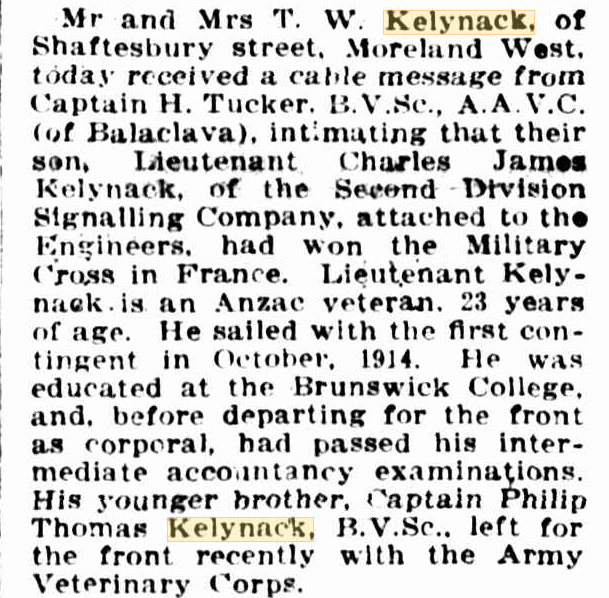
Charles Kelynack - motorcycling and life in Paris
This photograph comes from the Winner, 19 August 1914. It's a photo of a motorcycle race in progress. It was a 25 mile race from a mile outside Craigieburn to Wallan and back. The article goes on to tell us that ‘Kelynack got away well in his little two-speed Sunbeam. The healthy cackle of his exhaust must have been sweet music to his ears’… but later we are told that ‘Kelynack, the limit man, led all the way out, and was first round the turn at Wallan, but was to be seen soon afterwards on the roadside suffering from magneto troubles.’