I first wrote about Charles Kelynack in September 2013 and you can read my original blog post here.
Since then I've heard from a Frenchman, Jérémie Petit, who has sent me some photos and documents that add to Charles Kelynack's story. So I thank Jérémie for his generosity.
I've also taken a closer look at the newspaper collection on TROVE, and as usual it's come up trumps.
I hope you enjoy finding out more about what sounds like a very adventurous early life.
Charles Kelynack, the motorcycle rider
This photograph comes from the Winner, 19 August 1914. It's a photo of a motorcycle race in progress. It was a 25 mile race from a mile outside Craigieburn to Wallan and back. The article goes on to tell us that ‘Kelynack got away well in his little two-speed Sunbeam. The healthy cackle of his exhaust must have been sweet music to his ears’… but later we are told that ‘Kelynack, the limit man, led all the way out, and was first round the turn at Wallan, but was to be seen soon afterwards on the roadside suffering from magneto troubles.’
Charles Kelynack, the soldier
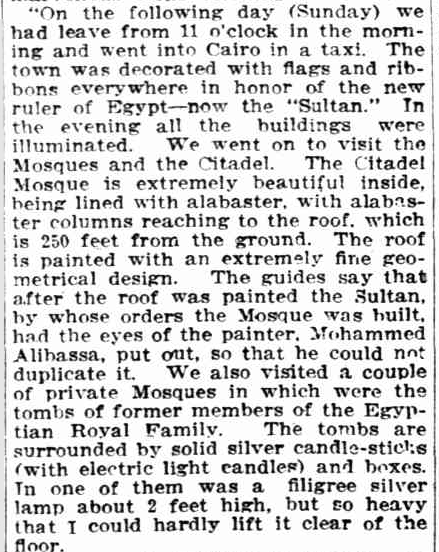
When it came time to join up, it will come as no surprise that Charles Kelynack continued his love affair with motorcycles. As a newly arrived Corporal, he wrote from the Mena House Hotel in Egypt where he was based with his 'corps of cyclists and signallers' (he was part of the 1st Divisional Signal Company) describing a visit to the Pyramids.
The visit was covered by the Herald and the Winner on 3 February 1915 under the sub-heading ‘Cyclists explore Pyramids with bicycle lamps.’ It begins ‘Motor cyclists will be interested to hear that the Pyramids have been explored by the light of an acetylene lamp. An interesting letter has been received from Corporal C.J. Kelynack, the well-known cyclist, who is now at Mena with his corps of cyclists and signallers.’
This is what he wrote:
Kelynack was not wounded during the war, although he became ill with measles and also had his appendix removed after being seriously ill with appendicitis in Egypt. The timing of his operation (reported in the Brunswick and Coburg Standard on 23 April 1915) suggests a lucky break in a way, because he was convalescing at the time of the ANZAC landing and missed the worst of the fighting on the Gallipoli Peninsula.
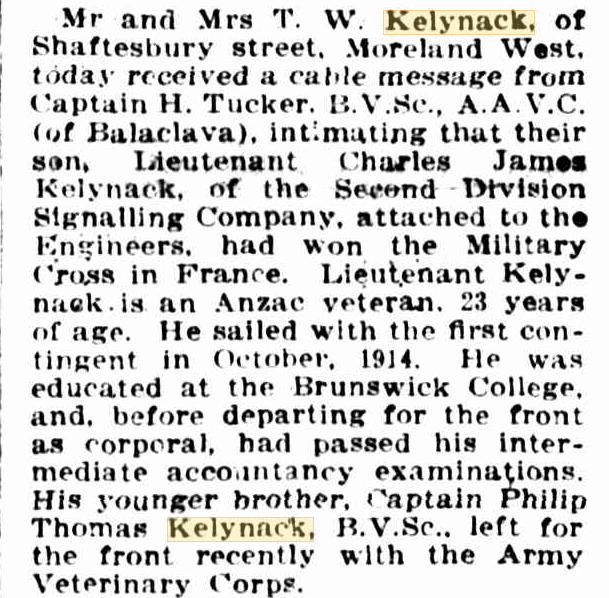
He went on to serve in France and by June 1916 he had been promoted to Lieutenant. He was awarded the Military Cross at the end of October 1917. Not long afterwards he was promoted to the rank of Captain.
Herald, 17 November 1917
Charles Kelynack, the married man
Kelynack married
at St Martin’s Register Office, London on 11 January 1919. He was then in the 5
Divisional Signal Company and gave his address as the Jermyn Court Hotel, Picadilly Circus.
He married Dora
Kreemtianka, of Kensington Palace Mansions, Kensington Gardens, an artist. In later documents her address is given as Mrs D. Kelynack, 328 Rue St. Jacques, Paris, although she followed him to Australia after his return in August 1919.
Photograph of Charles and Dora Kelynack around the time of their marriage. Courtesy Jérémie Petit
Dora Kelynack practised her art while here in Australia, and appeared in numerous newspaper articles, but in October 1922 the couple left Melbourne and settled in Paris, described in one paper as 'their beloved Paris'.
Extracts from Mme Kelynack's scrapbook. Courtesy Jérémie Petit.
Kelynack, an accountant in the Defence Department in Melbourne before the war, established a business in Paris and in the early 1920s he wrote regularly from Paris for the Sporting Globe, on a range of sports such as boxing, cycling, swimming and motorcycle racing.
The very last story published from him was in the Herald on 15 April 1926. The article, 'When snow falls on Paris', had been written on 2 February. Not long after (if my schoolgirl French hasn't let me down) he and his wife filed for divorce - on Bastille Day - 14 July 1926.
Divorce papers for Charles Kelynack and Dora Kucembianka. Courtesy Jérémie Petit.
Charles Kelynack, single man once more
Not long after the above copy of the divorce papers was made in June 1929, Charles Kelynack returned to the family home at 52 Shaftesbury Street, Coburg. His mother had died in September 1928. In 1930 his father, the sports journalist known as 'Kickero', retired. He had run the Herald's football section for 41 years, was a great all-rounder and also served as the paper's crime reporter for 40 years. (Herald, 11 October 1930). 'Kickero' died in 1936 and is buried at Coburg Cemetery with his wife Catherine.
From this point, Charles Kelynack lived a very private life. He did not remarry and there are no references to him in newspapers after his return from Paris until his death (at the family home) on 23 September 1950 aged 55.
Dora remarried in 1931, continued to paint and exhibit under the name Dora Bianka, and lived in France where she died in 1979 aged 84.