Wednesday, 8 January 2014

Killed by one of his own company

My last few blog entries focused on Coburg volunteers who died before they ever got a chance to fight. The shock for their families must have been immense. Having reconciled themselves to their boys going to war, they could not even console themselves with the knowledge that the boys (two of the three were only 18) had died fighting for their country.


3320 Private Charles Bruce Laugher, 5th Infantry Battalion, C Company.
Image courtesy AWM. Image H06466.


Another 18 year old who died accidentally was Charles Bruce Laugher, known as Bruce. The son of William James Laugher, bookseller and stationer of Kyneton and his wife Esther (nee Roff), Bruce Laugher was a clerk who had come to Melbourne to work. I cannot find any direct reference to him in Coburg, but he is remembered at the Memorial Avenue of Trees in Lake Reserve (his was tree number 142), so perhaps he worked somewhere in Coburg.  His older brother Stanley William, also a clerk, lived in Cooraminta Street, Brunswick at the outbreak of war, so perhaps Bruce came down to join his brother. Stanley also joined up, served as a sergeant with the 5th Battalion, was wounded in action twice and returned to Australia in January 1919. 

Yesterday I sat in the Heritage Room at the State Library of Victoria and read Bruce Laugher’s diaries and the last two letters he wrote home. His letters were written in a vivid, conversational manner and as I read, I could believe that I was right there with him. He wrote about some souvenirs he was sending home – a German helmet cover and some buttons.  He’d picked the buttons up in a hurry, he said. Then went on to add
It’s not as if a chap is on a tour where he could pick up souvenirs etc. One does not have time for anything like that until the last minute before he comes out of the line that is providing he is lucky enough to be amongst the ones that come out after it is all over. Well, Good Luck was with me in our “hop out” and I managed to come out of the line with the other lucky ones.
This must have been one of the last letters his parents read and in all probability they read it after they’d heard the news of his death, when his good luck had run out.

His last letter home, written on 18 September 1916, just 8 days before he died, says that it was getting cool at night and they’d soon be having frosts. He says they’ll need their scarves and gloves etc. One of those etcs, a balaclava, proved to be Bruce Laugher’s downfall. He was shot at Ypres while coming off patrol by a fellow member of his Company, Private R.H. Armstrong, who was on sentry duty. An eye witness reported that
Laugher had been out on a listening patrol, he returning over the parpapet at a place where he was evidently unexpected. On being charged by sentry he made no audible reply. He was again challenged and again failed to reply. The place was very lightly held and risky and the sentry fired and shot him through the head.

An Inquiry was held and the following findings were made: They were all aware of the password, but Laugher did not give it. 'No blame is attributable to anyone, but it seems possible that owing to the deceased having his balaclava wrapped round his ears he did not hear the challenge.' It transpires he was wearing a cap and not a steel helmet. 

It may be, of course, that he did hear the challenge and did give the password but his voice was muffled by the balaclava and was not heard by the sentry. We'll never know.

So, as predicted, the night was cool enough for Bruce Laugher to wrap up warmly, putting on a balaclava under his cap and it was this act of comfort that inadvertently led to his death. 

I find it hard to image how his family coped with his death, not killed as a result of combat, but by a comrade who could not have seen who it was, given that the balaclava would have covered Bruce's face and it was 4 am and barely light yet.

The local newspaper gave an account of Bruce Laugher’s death in which they claimed that he was ‘killed in action’. A more palatable version of the truth, or perhaps the full circumstances had not yet come to light?


Kyneton Guardian, Saturday 14 October 1916, page 2.


Sources:

Kyneton Guardian, 16 May 1916; Kyneton Guardian, 14 Oct 1916; Alpine Observer and North-Eastern Herald, 22 Dec 1916, p.1; Victorian electoral rolls, accessed via Ancestry; Victorian indexes to births, deaths and marriages, accessed via Ancestry; State Library of Victoria Manuscript Collection, MS 9607; Attestation papers of Charles Bruce Laugher and Stanley William Laugher; Australian War Memorial Red Cross Files; Coburg Historical Society collection; Australian War Memorial Roll of Honour Circular. 


Monday, 6 January 2014

An accidental death at Laverton


Another volunteer who is remembered at the Coburg State School Memorial Garden is eighteen year old Corporal Thomas Francis Quirke of 252 Sydney Road, Coburg, who died in an accident at Laverton on 15 January 1917.

At first I thought that he had died in a flying accident, however, the following newspaper article shows that he was thrown from a ‘motor waggon’, badly injuring his legs and died as a result of those injuries.

Brunswick and Coburg Leader, 19 January 1917, p.1.


Despite the fact that he did not die in battle, he was buried at Fawkner Cemetery with full military honours.


Brunswick and Coburg Leader, 19 January 1917, p.2.


Almost two years earlier, on 8 August 1915,  an older brother, William Michael, was killed in action at Gallipoli. William Quirke is remembered at Coburg’s Memorial Avenue of Trees, Lake Reserve. A third brother, John Victor, enlisted not long after Thomas’s death, on 17 April 1917, served overseas but on the Administrative Staff as a clerk. He returned safely to Australia. A cousin, William James Quirke, of Barry Street, Coburg, also served, and despite being wounded twice, returned to Australia.

Father John Quirke was a warder at Pentridge, as was his father's brother James (father of William James). In the 1920s, when William James returned from the war, the three men relocated to the McLeod Penal Settlement at French Island.

Mother Mary Josephine (nee Cashman) remained in Melbourne’s inner suburbs, living with her youngest son John Victor, who was the licencee of the Beehive Hotel, Barkers Rd., Hawthorn and then of the Terminus Hotel, Victoria Street, Abbotsford. They both died in 1928, she in March and he in December. Mary Quirke had accrued an estate of over  £13,000 pounds, nearly half of that in real estate. This she left to her husband, who died at Abbotsford in 1938 where he had lived with his oldest son John, who by then was the licencee of the Terminus Hotel.


Sources

Attestation papers for John Victor Quirke, Thomas Francis Quirke, William Michael Quirke and William James Quirke; Coburg Historical Society collection; Victorian birth, death and marriage indexes, accessed via Ancestry; Victorian electoral rolls, accessed via Ancestry; Brunswick and Coburg Leader, 30 July 1915, p.2; Werribee Shire Banner, 18 January 1917, p.3; Brunswick and Coburg Leader, 19 January 1917, pp.1&2; Argus, 8 April 1926, p.16; Argus, 18 May 1928, p.14; Argus, 22 December 1928, p.13; Will of James Quirke, PROV, VPRS28/P3/1518.

Saturday, 4 January 2014

Lost to the sea


It is nice in the surf


While I was thinking about the ways in which the First World War influenced our emergence as a nation, I came across this recruitment poster and it reminded me that even though we might think of the surfie as a much later creation, the sea has always been a major part of Australian culture. After all, apart from Canberra, which is a fairly recent (and artificial) creation, all our capital cities are on the coast. 


It is nice in the surf, but what about the men in the trenches? Lithograph printed in colour on paper, c. 1915. Artist: David Henry Souter. Published by the Win the War League. 
Image courtesy AWM. Image ARTV00141.


The poster also reminded me of the role the sea played in the deaths of two Coburg recruits who never did make it to the battlefields of France. They were cousins William Geddes and William Henry McKay, whose attestation papers comment that they died in a boating accident on 30 July 1917 at Anderson Inlet while on final leave, on the day before they were due to enter camp.


Anderson Inlet, Inverloch, South Gippsland. 143 kilometres (89 miles) from Melbourne. Today’s tourists go for its swimming, sailing, fishing, windsurfing and surfing opportunities. This photo does not even hint at the treachery of the stormy winter sea that would have faced William Geddes and William Henry McKay. 


The accident


On the afternoon of the accident, 18 year old William Geddes and his 28 year old cousin William Henry McKay were in Gippsland helping their uncle Thomas Hilliar who was moving building materials across the inlet. The uncle, who had been a Coburg labourer, had recently acquired land at Point Smythe from the Closer Settlement Board. He’d already fenced off his property and had built a three roomed weatherboard house on his land and on this trip he and his nephews were moving timber across ready for more construction. According to newspaper reports, the boat was ‘bottle shaped’, loaded with too much timber on top, and came to grief somewhere near the jetty at Point Smythe.
When the party had failed to land by 10pm, the inlet was dragged. The boat was found floating bottom upwards but there was no sign of the men. Only a few sticks of timber came ashore and it was two days before Hilliar’s body was found. One newspaper reported that he had ‘made desperate efforts to save himself from drowning, as he had taken off two coats, removed the lace out of one boot, and partly unlaced the other.’  
At the time of the accident, no mention was made of the recovery of William McKay’s body and I have been unable to locate a death notice or find him in the Victorian Death Index. A newspaper report ten months later says that he was found the same day as his uncle, but I suspect that his body was never found. Although he is listed on his parents’ headstone at Coburg Cemetery, the register of burials for Coburg Cemetery does not list him. It is likely that he shared the fate of so many young men who were killed in action in France and whose bodies were never found.
Amazingly, William Geddes’ body was found ten months after the accident. It had been buried in sand, having been washed high up on the beach some time before and ‘had lain there buried until the sand which covered it was removed by heavy seas’. He was identified by the military buttons on his clothes. His remains were brought to Melbourne by train and he was buried in the Baptist section of Coburg Cemetery (Compartment P, Grave 416) with his aunt and uncle, Fanny and John McKay.

Geddes-McKay grave in foreground. Thanks to David Down of the Friends of Coburg Cemetery for confirming that William Geddes was buried with the McKays and for providing me with the location of the grave.


Some family background


William Geddes

By the time he enlisted on 14 July 1917, both of William Geddes’ parents were dead, his father William in 1906 and his mother Ruth Annie (nee Hilliar) in 1909 (when he was 10). Only one child from his father’s first marriage was living at the time of William junior’s death, the much older Agnes who married William Boldman of Emerald in 1902 and had four children of her own, born between 1903 and 1910. It was his mother’s famliy who provided William with a home and family support. On his enlistment, he named his cousin Mary Elizabeth Jackson, daughter of his mother’s oldest sister, as his next of kin. At the outbreak of war she lived at 462 Sydney Road, Coburg, also the address of Thomas Hilliar and it is likely that the young William Geddes lived there with them, as he attended Coburg State School.

William Henry McKay

William Henry McKay was the eldest of nine children born to Scot John McKay and his wife Fanny Caroline Hilliar (sister of Ruth Annie Geddes and Thomas Hilliar). Like his siblings, William was born in Coburg. William attended Coburg State School and is featured in the school’s World War One Soldiers Book, although, unlike so many others, his entry does not include a photograph.

Image courtesy Coburg Historical Society.

This was an enterprising family. The McKay family were well known dairy farmers who had properties in Newlands Road, Coburg until the 1960s. Like her sister Ruth, William’s mother Fanny McKay died young, in 1912. Interestingly, we know from her probate papers that between 1897 and 1911 she had bought three lots of land totalling 26 acres with her own money, all in Newlands Road, Coburg, land which she left to her husband on her death. Probate papers reveal that at the time of his death, 28 year old William Henry McKay was well on the way to establishing himself. He had bought 17 acres of land in the Parish of Keelbundora valued at £350. He had 4 cows, 4 heifers, 2 horses and 10 hives of bees. He also had over £200 in the bank. Alan, the youngest son of the family, owned 200 acres of land which he sold to Kodak and to the owners of the Coburg Drive-In in the 1960s. Even then he continued on leased land along Edgars Creek until 1976 when the McKay’s long association with Coburg’s dairy industry ended.

The Hilliar family

As I researched this story, I became aware of a wide-reaching and loving family network based around the Hilliar family.
Henry Hilliar and his wife Sarah Beaton had seven children born in Brighton between 1856 and 1867. Two died young, but several played a supportive role in the lives of young William Geddes.
Eldest daughter Mary Elizabeth married Joseph Jackson in 1877 and it was her daughter, also Mary Elizabeth, who lived for a time in Coburg and is listed as William Geddes’ next of kin.
Thomas Hilliar, born in 1861, died with William Geddes and William McKay on 30 July 1917. He was the father of six, including a son Henry, who had enlisted in Western Australia in August 1914 and was killed in action in France on 30 May 1916. The family lived with Mary Jackson at 462 Sydney Road, Coburg in the early days of the war, so the cousins would have known each other well.

Neither William Geddes nor William McKay got the chance to fight for their country, but they are still remembered amongst Coburg’s war dead, not in the Memorial Avenue of Trees at Lake Reserve but in the Memorial Garden planted to the south of Coburg State School’s Infant School. William Geddes’ was tree number 33 and William McKay’s was tree number 8.
The trees no longer exist, but it is hoped that some form of additional commemoration will take place during the next four years. Your suggestions on how this might be done are welcome.
Image courtesy Coburg Historical Society.


A note on sources

I pieced together this story using many different sources, which I’ve listed below. I was amazed at how many interstate and country newspapers covered the boating accident story and it’s a reminder that it’s always worth looking at them all as I often found a little bit of extra information to add to the overall story by looking beyond the obvious sources. The newspaper reports were found in the National Library of Australia’s TROVE. I also found the Victorian Wills and Probate papers extremely useful. They’re freely available online through the Public Record Office of Victoria website. By locating William Geddes’ father’s will, for example, I discovered that William Geddes, the soldier, was the only child of his father’s second marriage. I also discovered the names of his half siblings, whom I had not been able to locate until then. I used Ancestry to get birth, death and marriage information. Even if you don’t have your own subscription, don’t forget to ask at your local library, because many libraries provide Ancestry. My final source was the Coburg Historical Society collection and in particular the Coburg State School Soldiers Book. The original of this can be found at the Society’s museum (Bluestone Cottage, 82 Bell Street, Coburg). There is an index and a fascimile of the book available for use at the Cottage during its opening times (1st Sunday of each month, 2 to 4.30).

Sources

Argus, 1 August 1917; Broken Hill Barrier Miner, 1 August 1917; Brisbane Courier, 1 August 1917; Powlett Express and Victorian State Coalfields Advertiser, 3 August 1917; The West Australian, 18 August 1917; Western Mail, 24 August 1917; Zeehan and Dundas Herald, 25 August 1917; Pakenham Gazette and Berwick Shire News, 17 May 1918; Adelaide Daily Herald, 17 May 1918; Adelaide Advertiser, 17 May 1918. Victorian Birth, Death, Marriage indexes (accessed via Ancestry); Victorian electoral rolls (accessed via Ancestry); Probate and Will of Thomas Hilliar, PROV, VPRS28/P3/748 and VPRS7591/P2/567; Probate and Will of William Geddes, PROV, VPRS28/P/1272, VPRS 28/P2/755, VPRS7591/P2/388; Probate and Will of Fanny Caroline McKay, PROV, VPRS28/P3/306; VPRS7591/P2/482; Probate and Will of William Henry McKay, PROV, VPRS28/P3/769, VPRS7591/P2/572; AIF attestation papers for 67879 Private William Geddes, Private William Henry McKay, 522 Sergeant Henry Hilliar, 11th Infantry Battalion; Coburg Historical Society collection; Richard Broome, Coburg Between Two Creeks.


Thursday, 2 January 2014

War comes to Australia


Some years ago when I was researching the life of a left-wing woman teacher, who was also a social and peace activist, I was deeply impressed by historian Eric Hobsbawm's book The Age of Extremes: the short twentieth century: 1914-1991 (published in 1994 by Joseph). Here he argued that the twentieth century really began with the First World War and ended with the fall of the Soviet bloc.


Now that we have entered 2014 and are approaching the centenary of the beginning of the First World War, it is timely to consider in what ways a national consciousness emerged with the coming of the war. 

For one thing, Australians had fought as separate colonial forces (that is, as Victorians, South Australians, New South Welshmen and so on) for most of the Boer War from 1899 to 1902. It was there that the rising star badge first appeared, but it was not until the 1914-1918 war that the iconic image of the Aussie 'Digger' emerged, in his Digger's slouch hat (featuring the rising star badge) and with a growing reputation as a 'larrikin' soldier, brave in the line of fire but with little respect for the rigid discipline of army life or for the perceived pomposity of British officers.


And, of course, the almost sacrosanct notion of 'mateship' emerged from the debacle at Gallipoli to become part of the world's image of Australians for the century to follow. A mate is more that just a friend. He is someone who shares your experiences with you; someone you can rely on no matter what. The idea had been there in Henry Lawson's short stories and poetry and probably originated in convict days, but it was during the First World War that the term really found its place in the Australian consciousness. 


Perhaps it could be argued, too, that the war was a leveller, with men from all sections of society fighting side by side, equally at risk of death, dependent on one another during a period of great stress unlike anything they had ever experienced before. The first step, then, in the breakdown of class divisions?

And how much of our language has been influenced by WW1 Diggers' slang? 'G'day digger', we hear and don't think all that much about where the term came from. C.J. Dennis's 'Digger Smith', which featured in some of my earlier blogs, reminds us of the important role the little 'digger' played in our emerging nationhood.

Click here to read 'Digger Smith' online.


It's only recently that I've  started to think about this whole issue of how World War One influenced the emergence of Australian nationhood. I would be interested to hear your thoughts on the comments I have made here.  Perhaps you have other ideas on the way WW1 helped to shape our nation. 


Tuesday, 17 December 2013

Desperate to serve: William Henry George Barry's war

6224 Private William Henry George Barry, 14th Infantry Battalion, 20th Reinforcements.


William Barry was born in Coburg (then known as Pentridge) in 1869, the son of William and Isabella (Johnson). He did not marry and lived with his widowed mother Isabella (nee Johnson) at 3 Barry Street (or Barry's Lane), Coburg, a street off O'Hea Street named after his family.

William Barry was 44 years old when he enlisted. By then he'd served in the Australian Navy for three years and been in the 1st and 4th Battalions of the Victorian Militia for four years. He'd done home service, too, with the AIF, for four months. A big man for the time (5 feet 9 inches tall and weighing 13 stone) and used to hard physical work (he was an ironworker on the railways), he'd been rejected as unfit before with a hammer toe and bad teeth. Even so, he wanted to fight and he was finally accepted in August 1916. He embarked from Melbourne on 7 September 1916 on board the Port Sydney.

Port Sydney on the day of its departure, 7 September 1916. Photographer Josiah Barnes.
Image courtesy AWM. Image PB0910.


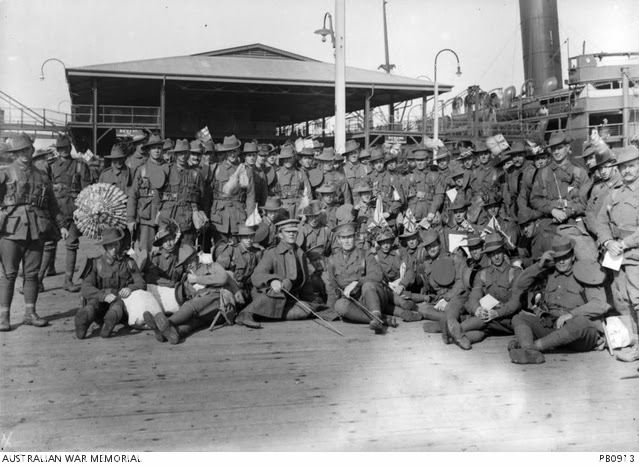
20th Reinforcements of the 14th Battalion on the wharf at Port Melbourne, ready to embark. 7 September 1916. William Barry is probably in this photo.
Image courtesy AWM. Image PB0913.

Port Sydney,  20th Reinforcements, 14th Battalion. Note that the patterned sunshade that is on the left in the photo above is now being used as shelter by the two soldiers on the left. Was it a gift from a sweetheart, perhaps?
Image courtesy AWM. Image PB0917.

There are many more photos of the Port Sydney taken that day. They are all available online at the Australian War Memorial website and were all taken by Josiah Barnes, a photographer from Kew whose two sons served in the 1st AIF. He was known as the 'embarkation photographer'. 

----

William Barry arrived in France on 3 March 1918. He was wounded in the thigh and hand on 31 May 1918. On 13 June 1918, aged 47, he was sent back to England with haemorrhoids. At the end of July he was returned to Australia suffering from premature senility, which the medical report claimed was pre-existing. It also noted that he had 'markedly defective vision' in his right eye.

It's a wonder he was ever accepted in the first place, but William Barry's four months in France gave him a taste of the experience of war and on his return he was granted a pension. He lived with his mother at 3 Barry Street, Coburg until the 1920s when he moved briefly to Gisborne. By then he was working as a gardener, an occupation he continued to pursue on his return to the city, to Abbotsford, in 1931. He lived alone, his mother having died in 1929. I have found no record of his death.

Interestingly, during the war years, his sister Elizabeth, who was married to Chief Warder Hugh Foy, lived inside the walls of Pentridge Prison. His father William, who died in 1909, had been a warder at Pentridge in the 1870s and 1880s.

Sources: Attestation papers, National Archives of Australia; Victorian Birth Index, 1869/10711; 1903, 1909, 1914,1919, 1924, 1931 and 1936 electoral rolls.


Wednesday, 11 December 2013

From life on the sea to a war in the air: Edmund James Lee Barker's war


1427 2nd Air Mechanic Edmund James Lee Barker, Australian Flying Corps, 8th Reinforcements.


A group of Australian Flying Corps men awaiting embarkation.
Image courtesy AWM. Image C03972.


When he enlisted in the Australian Flying Corps on 5 January 1917 as a 30 year old married man, Edmund Barker had already experienced life at sea. He had served 18 months in the Royal Navy and been invalided out in 1904 when he was only 17. His attestation papers give no indication of his illness or condition, but 13 years later he was considered fit enough to head over to Europe to fight the Germans.
He and his wife Julia Campbell Skinner, whom he married in 1911, are recorded as living at 9 Davis Street, South Yarra at the time of his enlistment but on his return he set up an electrical contractor's business in Sydney Road, Coburg. He died at Coburg East in 1948 aged 61.

Sources include: Attestation papers, National Archives of Australia; Victorian Marriage Index, 1911/6359; 1919 electoral roll; Victorian Death Index, 1948/2559.

Group of Royal Flying Corps and Australian Flying Corps mechanics outside a workshop.
Image courtesy AWM. Image C03725.


Saturday, 7 December 2013

Thrown from his horse

Norman John Embelton's war ended just as most other's started


Navy Pay Clerk Norman John Embelton (sometimes spelled Embleton) was born in 1894 in Victoria's north-west, at Lake Charm, near Kerang. (Coincidentally, I was born in Kerang nearly 60 years later.) His father Robert was a teacher with the Victorian Education Department, so the family moved around the state but by the time of Norman's death on 31 March 1915, he lived with his parents in Westgarth Street, Northcote. He was only 20, but had already served in the Australian Navy and like Oriel Ashton had served in New Guinea. At the time of his death he was home on leave suffering from malaria. No doubt he thought that now that the German raiders had been cleared from the area and German New Guinea had fallen, he would soon be heading to Egypt on board one on the many troopships destined to cross the water on their way to Egypt, the Dardanelles and ultimately France and Belgium.

A cat placed on a chair on deck with a dog called Cabby. The dog was picked up while swimming in the Sepik River, New Guinea, and then served in the Australian Navy New Guinea Flotilla from 1914 to 1919. (Donor Captain A.G. Bond)  
Image courtesy AWM. Image H15227.


Norman Embleton's war was cut short on 30 December 1915. He was riding along Epping Road, Preston with friends when his horse stumbled and bolted. He was unseated, his foot stuck in the stirrup and he was dragged a considerable distance by the stirrup leather before his friends managed to extricate him. He was taken to hospital unconscious and died the next day.

He is buried in the Church of England section of Coburg Cemetery, Compartment P, Grave 479.

Coburg Cemetery Gates, c. 1908. 
Image courtesy Coburg Historical Society.


His older brother David, a doctor, had left for the war in November 1914 and served on the Gallipoli Peninsula and France. A Major, David Moore Embelton was awarded the Most Excellent Order of the British Empire (Military) and was twice Mentioned in Despatches and returned to Australia in April 1919.

Sources include: Darebin's Great War - In Memorium, p.191; Service records held at the National Archives of Australia; Coburg Cemetery records;  Argus, 14 April 1915, p.10; Adelaide Register, 1 April 1915, p10; Weekly Times, 3 April 1915, p.33; Patsy Adam-Smith, The Anzacs.